
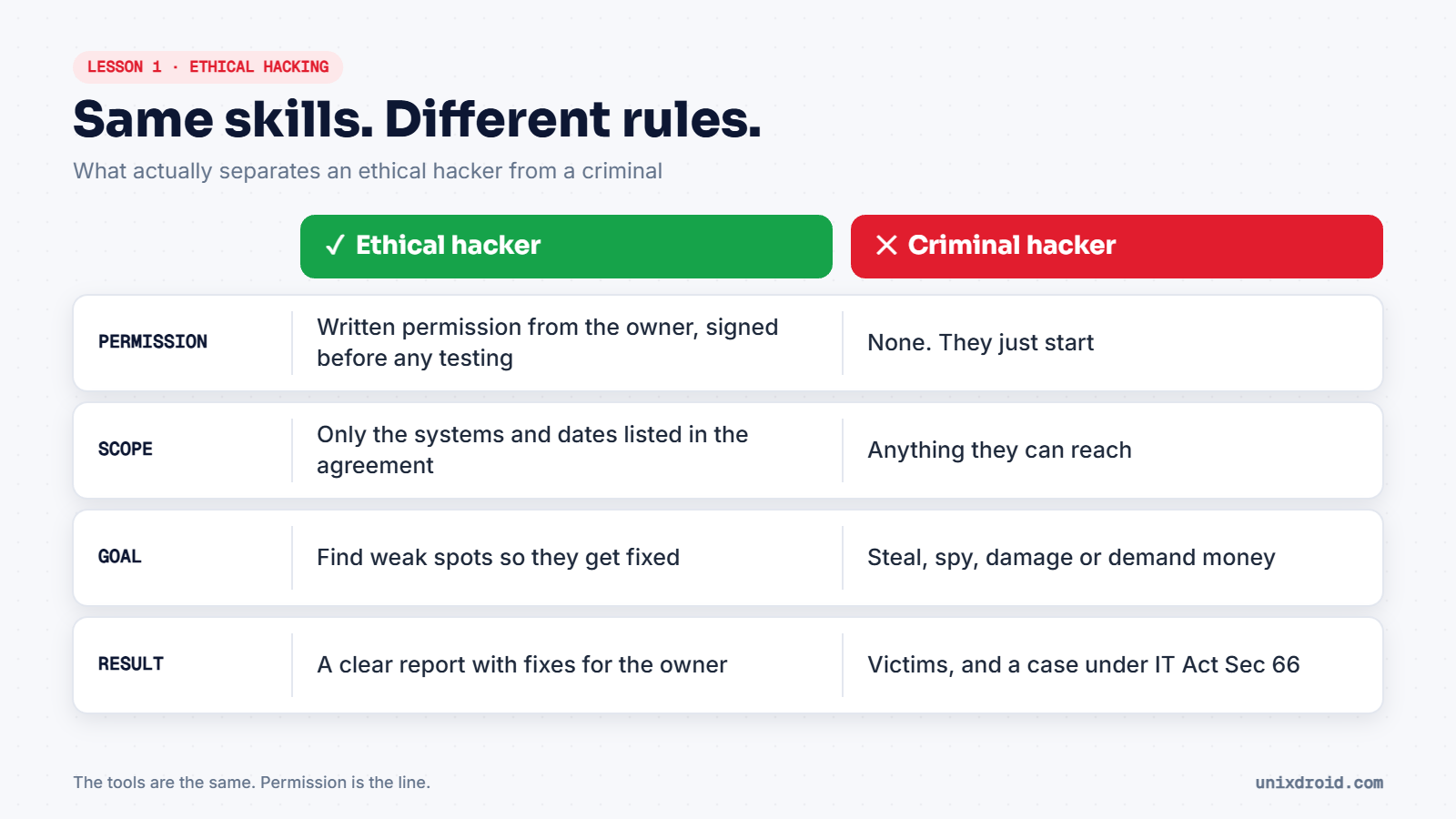
Ethical hacking means breaking into computer systems with the owner's permission, so the weak spots get fixed before a real attacker finds them. Companies pay for this because it's far cheaper to hear "your login page can be bypassed" from a tester than from a criminal.
Here's the surprising part: an ethical hacker and a criminal use almost the same tools. Nmap, Burp Suite, Metasploit, Wireshark. The difference isn't skill or software. It's permission.
The three things every test needs
Every real security test rests on three things. Learn them before you learn a single command.
| What | Meaning | Example |
|---|---|---|
| Permission | The owner agrees, in writing | A signed contract or authorisation letter |
| Scope | Exactly what you may test | "Only app.example.com, not the payment server" |
| Rules | How and when you may test | "10 PM to 6 AM only, no denial-of-service" |
If even one is missing, it isn't a test. It's an attack.
"I was only checking if it was secure" is not a defence. Without permission, good intentions don't count.
What the law in India says
India's main cyber law is the Information Technology Act, 2000. Two sections matter most for beginners:
- Section 43 covers accessing a computer, copying data or damaging a system without the owner's permission. The person responsible can be ordered to pay compensation.
- Section 66 turns those same acts into a crime when they're done dishonestly or fraudulently. The punishment can be up to 3 years in prison, a fine of up to ₹5 lakh, or both.
Other countries have similar laws, such as the Computer Fraud and Abuse Act in the US and the Computer Misuse Act in the UK. Wherever you live, follow one rule: no permission, no testing. (This is a simple summary to keep you safe, not legal advice.)
White, black and grey hats
- White hat: works with permission. Penetration testers, bug bounty hunters, red teamers.
- Black hat: breaks in without permission, for money, data or damage.
- Grey hat: breaks in without permission but claims good intentions, sometimes reporting the bug afterwards. It's still illegal, and plenty of grey hats have ended up in trouble.
Everything on UnixDroid Journey is about being a white hat.
Where you can practise legally
You don't need anyone's permission to hack your own machines, or platforms built for practice. That's where every beginner starts:
- Your own lab of virtual machines. You'll build one in lesson 3.
- TryHackMe and Hack The Box, which give you machines you're allowed to attack.
- OverTheWire wargames like Bandit, great for Linux practice.
- Bug bounty programs on HackerOne or Bugcrowd, later, once you know the basics. Each program publishes its own scope. Anything outside it is off limits.