
OWASP (the Open Worldwide Application Security Project) publishes a list of the most critical web application risks. It's the map most web testers and developers use. The current edition is the 2025 list.
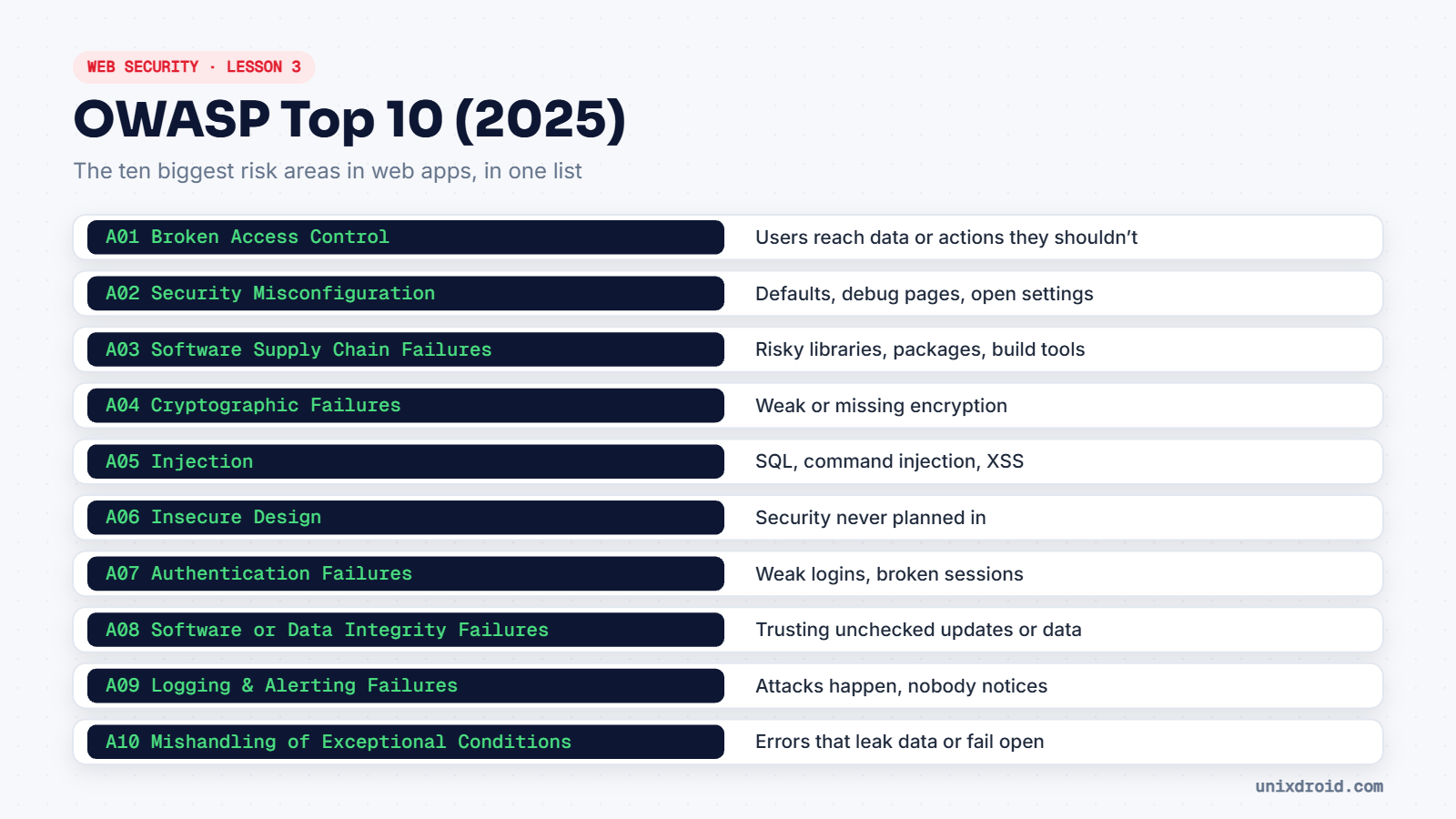
Each one, in plain words
A01 Broken Access Control. You change /account?id=1001 to id=1002 and see someone else's account. Server-side request forgery (SSRF) is now counted here too.
A02 Security Misconfiguration. A default admin password, a debug page left on, a cloud storage bucket open to everyone.
A03 Software Supply Chain Failures. The app pulls in a library or package that is outdated, abandoned or deliberately poisoned.
A04 Cryptographic Failures. Passwords stored with weak hashing, or sensitive data sent without encryption.
A05 Injection. User input ends up running as code: SQL injection, command injection, and cross-site scripting.
A06 Insecure Design. The flaw is in the plan itself, like a password reset that only asks for your date of birth.
A07 Authentication Failures. No limit on login attempts, weak password rules, sessions that never expire.
A08 Software or Data Integrity Failures. The app trusts updates, plugins or data without checking they are genuine.
A09 Logging & Alerting Failures. Attacks happen and nobody notices, because nothing was logged or nobody watched the logs.
A10 Mishandling of Exceptional Conditions. Errors that leak internal details, or systems that "fail open" and let you in when something breaks.
How to use the list
Don't treat it as a checklist that covers everything. It's an awareness list: the risk areas you should understand first. Each category contains many specific weaknesses.
Where to practise
- DVWA, already on your Metasploitable VM
- OWASP Juice Shop, a modern vulnerable shop app you run locally
- PortSwigger Web Security Academy, free labs in the browser
The next two lessons cover the two attacks beginners meet first: SQL injection and XSS.