
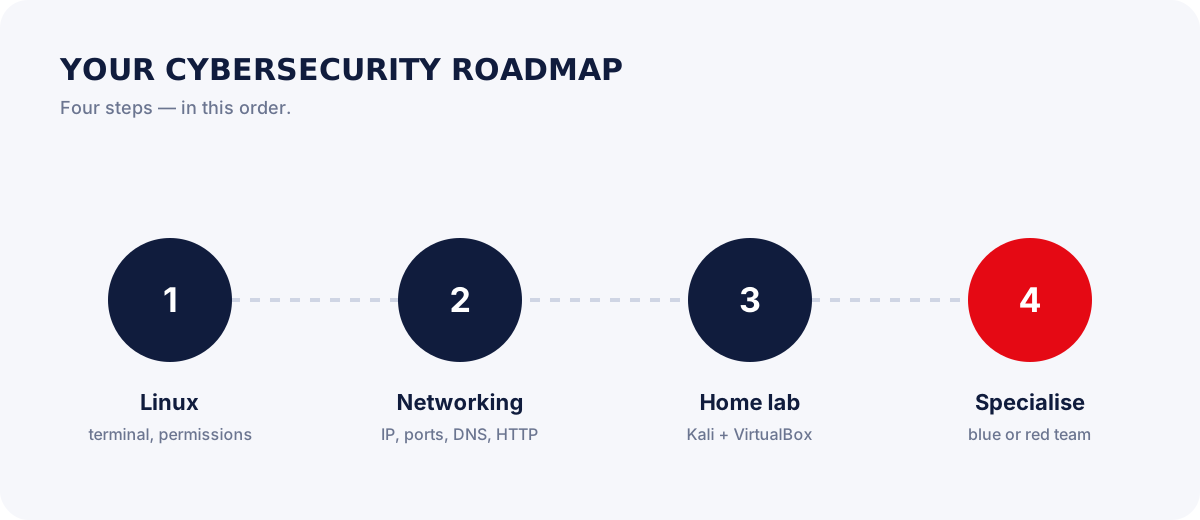
Cybersecurity looks huge from the outside — hundreds of tools, certifications and buzzwords. The good news: almost everyone who gets good at it follows the same four steps.
Start with the fundamentals
Before touching any hacking tool, get comfortable with Linux and networking. Most security work happens on a terminal, and almost every attack or defence involves the network.
- Navigate the filesystem, manage users and permissions
- Understand IP addresses, ports, DNS and HTTP
- Read logs without being scared of them
Build a home lab
Install VirtualBox, a Kali Linux VM and an intentionally vulnerable machine. Practise only on systems you own or have written permission to test.
sudo apt update && sudo apt install -y nmap
nmap -sV 192.168.56.101   # your own lab VM
Pick a direction
Blue team (SOC, incident response) is about detecting and stopping attacks. Red team (pentesting) is about finding weaknesses first. Both start from the same fundamentals — so you don't have to choose on day one.